
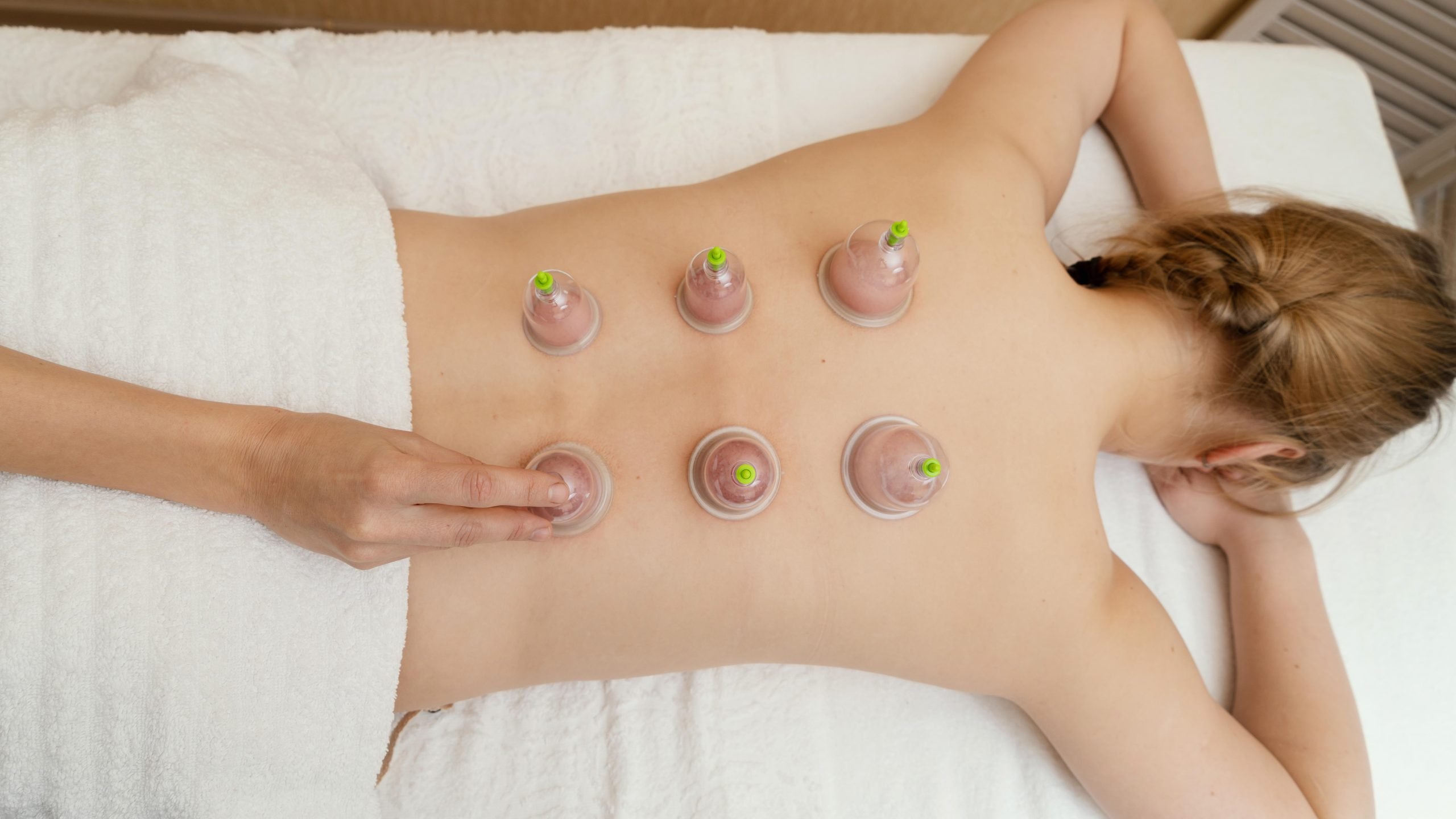
Machine vacuum cupping under infrared light
Modern vacuum therapy combined with infrared radiation for deep tissue regeneration
Planning your first visit?
If you are planning your first visit with us, we recommend filling out the health questionnaire before booking your chosen service. Based on the questionnaire, we will assess whether the service is suitable for you and, if necessary, recommend the next steps.
Fill out health questionnaireVacuum therapy and cupping have been experiencing a massive renaissance in recent years. The typical marks from cupping jars are increasingly visible on elite athletes and ordinary people seeking relief from chronic back and muscle pain. Despite its popularity, however, many myths circulate about this method.
At the Zlaté zdravie centre, we go a step further — we perform cupping under an infrared heater that evenly covers the entire treated area. The combination of precise machine-generated vacuum and the deep warmth of infrared light creates a synergistic effect that amplifies the benefits of both methods.
Let us look at the science behind how vacuum combined with infrared light actually works and why our body needs it during recovery.
What is the difference between cupping, vacuum, and gradient therapy?
Although all these methods harness the power of vacuum, they differ in technology and the depth of their effect on tissue.
Traditional Cupping
One of the oldest methods, with roots tracing back to ancient Rome, China, and Egypt. Using fire or a pump, static negative pressure is created in a cup. This acts primarily on the surface, creating local hyperemia and releasing tension in superficial muscles.
Vacuum Therapy (Medical Standard)
In modern surgery, negative pressure is used as VAC therapy (Vacuum Assisted Closure) to treat difficult-to-heal wounds. A computer-controlled pump precisely doses the negative pressure, which removes excess fluid from the wound and mechanically stimulates cells for faster formation of new tissue.
Vacuum Gradient Therapy (VGT)We provide this
This is the most technologically advanced form of negative pressure treatment, which we also provide here at the Golden Health center. The method was developed based on years of research by physician and scientist P. P. Michajlichenko. Unlike conventional cupping, which pulls tissue only vertically (upward), gradient therapy applies several cups of different sizes with varying negative pressure intensities simultaneously. This creates both vertical and horizontal pressure differences (gradients). This "double pull
Pulse cupping: Gymnastics for vessels and tissues
An extremely effective upgrade is pulsed (impulse) cupping. The device we use does not work with static suction alone, but with rhythmically alternating vacuum – tissue is rapidly drawn in and released at short intervals.
This dynamic process also acts as a perfect vascular workout. The rhythmic pulsation mechanically massages vessel walls, trains their elasticity, and dramatically accelerates blood and lymph flow. Professional studies confirm excellent results of pulsed therapy in neurology (for neuralgias and nerve plexus inflammations), ophthalmology (improved blood supply to eye structures), and gynaecology, where it helps restore pelvic organ function.
What happens under the skin?
Microcirculation and lymph
Most disease states begin in the microcirculation – the network of the tiniest capillaries that nourish cells. Stress, lack of movement, or poor posture cause these vessels to constrict. Tissue stops ‘breathing’, toxins accumulate, and ischaemia (poor blood supply) and venous-lymphatic stasis (fluid flow stoppage) develop. The tissue then stiffens and hurts.
Application of precise vacuum (VGT) triggers these processes:
Metabolic Impulse
Healing substances (histamine, prostaglandins) are released deep in the tissue and blood vessels rapidly dilate. Mechanical pressure stimulates the production of nitric oxide (NO), which forces contracted tissue to immediately relax.
Activation of "Sleeping
Negative pressure opens previously unused capillaries. Their number in the treatment area can increase up to 45-fold and blood flow velocity increases 4 to 5 times.
Acceleration of Lymphatic Flow
Lymph removes waste products from the body. Vacuum accelerates its flow 7 to 8 times, rapidly flushing toxins, swelling, and inflammatory products from the intercellular space.
Neoangiogenesis (Formation of New Vessels)
Scientific studies have proven that negative pressure mechanically stimulates the endothelium (vessel lining) to build completely new blood vessels, permanently restoring viability to damaged areas.
Infrared light: What it does in the body and why we combine it with cupping
At Zlaté zdravie, we use a professional Philips Vitae infrared heater that produces the full IR spectrum (IR-A, IR-B, IR-C) with a pronounced peak around 1,000 nm. It is the closest to the infrared spectrum of sunlight that an artificial source can produce. The heater evenly covers the entire treated area (most commonly the whole back) — it is not a point light source.
Infrared light is not just pleasant warmth. At the cellular level, it triggers a whole range of processes that amplify and complement the effects of vacuum cupping:
Deep Tissue Penetration
Infrared radiation with a peak around 1,000 nm (IR-A) penetrates 4–6 mm below the skin surface into the subcutaneous tissue and muscles. Unlike surface heat (e.g., warm compress), energy reaches directly to tissues that are the target of cupping.
Increased ATP Production
Infrared photons are absorbed by mitochondria — the "powerhouses
Vasodilation and nitric oxide release
IR light causes the release of nitric oxide (NO) from mitochondria, leading to blood vessel dilation (vasodilation). Increased blood flow accelerates the delivery of oxygen and nutrients to the treated area while enhancing the removal of metabolic waste.
Collagen stimulation and healing
IR radiation activates fibroblasts — cells responsible for producing collagen and elastin. Studies confirm accelerated wound healing, scar softening, and overall improvement in tissue quality in the treated area.
Anti-inflammatory effect
Infrared light reduces levels of pro-inflammatory cytokines (TNF-α, IL-6) and increases anti-inflammatory interleukin IL-10. Tissue inflammation is suppressed at the cellular level, which is crucial for chronic pain conditions.
Analgesic effect (pain relief)
Heat produced by infrared radiation acts on nerve endings — reducing pain signals, releasing muscle tension, and contributing to overall relaxation. For the client, this creates a pleasantly warming sensation throughout the entire session.
Synergy of vacuum and infrared light
Each of these methods is effective on its own. However, their combination creates an effect that exceeds a simple sum — the methods mutually amplify each other:
Negative pressure + heat = double effect on circulation
Vacuum mechanically opens capillaries "from below
Faster toxin elimination
Cupping accelerates lymphatic flow 7-8 times. Infrared light additionally stimulates cellular metabolism, allowing waste products to be both produced and eliminated more efficiently simultaneously.
Reducing initial discomfort
Negative pressure during cupping initially feels unusual. The pleasant heat from the radiator significantly reduces this sensation — tissue relaxes more quickly under heat and the client experiences the session more comfortably.
Deeper penetration into fascia and muscles
IR radiation pre-heats tissue to depth. Warmed fascia and muscles become more pliable, allowing negative pressure to penetrate deeper and more effectively break up adhesions and myofascial blocks.
Contraindications for infrared light
Infrared light is generally a safe method, but there are conditions where it should not be used: acute inflammations and febrile illnesses, active bleeding and blood clotting disorders, varicose veins at the application site, oncological diseases (the stimulatory effect could promote tumour cell growth), pregnancy, presence of a pacemaker or insulin pump, and impaired heat sensation. During application, it is important to protect the eyes and maintain safe intensity — the warmth should be pleasantly warm, never burning.
At the Zlaté zdravie centre, we regulate the heater intensity with a dimmer and individually adjust it to each client’s subjective sensation.
Where has vacuum therapy been proven to help?
Thanks to the restoration of microcirculation, the range of applications is enormous:
Musculoskeletal System
Back pain, osteochondrosis, muscle spasms (myofascial syndrome), joint arthritis, and rehabilitation after injuries.
Surgery and Wound Treatment
Accelerated healing of chronic and purulent wounds, diabetic foot syndrome, and treatment of extensive burns (healing acceleration up to 2.5 times).
Neurology
Migraines, chronic fatigue, sleep disorders, and autonomic dystonia.
Dermatology and Cosmetics
Scar smoothing, cellulite reduction (breaking down clustered fat cells), and skin rejuvenation through massive oxygen supply.
Facts vs. Myths: Does vacuum therapy have a scientific basis?
The claim that vacuum therapy is unsupported is a common misconception arising from lack of awareness. Professional literature and the history of medicine speak clearly:
As early as the 19th century, the famous surgeon N. I. Pirogov used negative pressure for wound cleaning.
— N. I. Pirogov (19th Century)German surgeon August Bier published groundbreaking work on treatment using artificial hyperemia with negative pressure.
— August Bier (1906)Surgery professors published results of 20 years of research on vacuum effectiveness in treating severe infections.
— J. A. Davydov and A. B. Larichev (1999)Describes in detail the physiology of gradient negative pressure and its ability to slow cellular aging. These effects are now protected by several medical patents.
— P. P. Michajlichenko (2005)Vacuum therapy is a strictly scientifically and physiologically grounded method. It introduces nothing foreign into the body – it ingeniously uses the physical principle of vacuum to ‘unlock’ and kick-start incredibly powerful self-healing processes that are natural to our organism.
Who is vacuum therapy suitable for?
Thanks to its comprehensive effect on microcirculation (blood supply and lymph flow), vacuum and especially vacuum-gradient therapy (VGT) is used across an enormous range of medical fields. It has been clinically proven effective for:
Musculoskeletal Disorders
Venous stasis-ischemic soft tissue disease, chronic myofascial pain, persistent muscle spasms and adhesions, spinal osteochondrosis, intervertebral disc herniation, scoliosis, arthrosis and arthritis of the joints. It also serves as excellent rehabilitation after sports injuries, fractures, or in cases of poor posture.
Neurological Problems
Migraines, tension headaches, neuritis, neuralgia, radiculitis (inflammation of spinal nerve roots), cerebral ischemia, and even as supportive therapy for cerebral palsy in children or Parkinson’s disease.
Cardiovascular Diseases
Ischemic heart disease, hypertension (high blood pressure) stage I and II, hypotension, and neurocirculatory dystonia.
Respiratory and Digestive System
Chronic bronchitis, asthma (outside of acute attacks), convalescence after pneumonia, as well as chronic gastritis, gastric ulcers (only in remission), obesity, and chronic constipation.
Urology and Gynecology
Erectile dysfunction, frigidity, chronic inflammatory diseases of the pelvic organs (prostatitis, adnexitis), or nocturnal enuresis.
Dermatology, Surgery and Cosmetics
In surgery, for the treatment of chronic, hard-to-heal, and purulent wounds and ulcers. In aesthetics, for smoothing wrinkles, removing double chin, combating cellulite, rejuvenating sagging facial skin, and softening scars.
When to definitely avoid vacuum therapy?
Despite being a highly physiological and natural method, it also has strict limitations. It must not be applied in conditions where increased blood flow could harm the body. Absolute contraindications include:
Absolute contraindications
Acute infections and inflammations: Any conditions accompanied by fever, acute inflammatory processes in the heart (myocarditis, pericarditis), acute appendicitis, or acute purulent and fungal skin diseases directly at the application site.
Severe cardiovascular diseases: Stage III hypertension, recent myocardial infarction, decompensated heart defects, severe heart failure, grade II and III varicose veins, and thrombophlebitis.
Bleeding risk: Hemophilia (blood clotting disorder), increased bleeding tendency, acute bleeding gastric ulcers, uterine bleeding, and conditions immediately following reconstructive vascular surgery.
Oncology and severe conditions: Presence of malignant tumors, extreme physical exhaustion, severe mental disorders associated with affective states and seizures.
Fresh injuries: Acute stage of injury accompanied by extensive hematoma.
Important Notice — Area Restrictions
There are also areas of the body where vacuum cups must never be applied for safety reasons. These include the region of the heart, directly over the eyes, and the ears.
Application to Breasts and Nipples — Partial Contraindication
Application of vacuum cups to breasts and nipples is partially contraindicated. Generally, conventional cupping is not applied to these areas. However, there are indicated cases — for example, mastitis — when this procedure is performed, but exclusively under the supervision of an experienced specialist.
Historically, negative pressure was used in folk medicine on the breast area.
Relative contraindications
Physicians also recommend considering contraindications in cases of unclear diagnoses, severe intoxication, extreme physical exhaustion in untrained individuals, in infants, and in elderly persons over 90 years of age.
Combination with hirudotherapy
In some cases, we combine vacuum cupping with hirudotherapy (leech therapy). Both methods complement each other: the vacuum restores microcirculation and prepares the tissue for the deeper action of biologically active substances from leeches (hirudin, hyaluronidase, destabilase, and others). Together, they achieve a synergistic effect that amplifies the benefits of both methods.
The combination is particularly effective for chronic musculoskeletal pain, vascular problems, and overall body regeneration. We will be happy to advise you on the most suitable combination of therapies during a consultation.
Viac o hirudoterapiiVacuum therapy combined with infrared light is a strictly scientifically and physiologically grounded method. It introduces nothing foreign into the body – it ingeniously uses the physical principle of vacuum and the energy of infrared light to ‘unlock’ and kick-start incredibly powerful self-healing processes that are natural to our organism.
Have questions about vacuum cupping suitability?
Contact us for a professional consultation. We will be happy to advise you whether vacuum cupping under infrared light is suitable for your specific condition.