
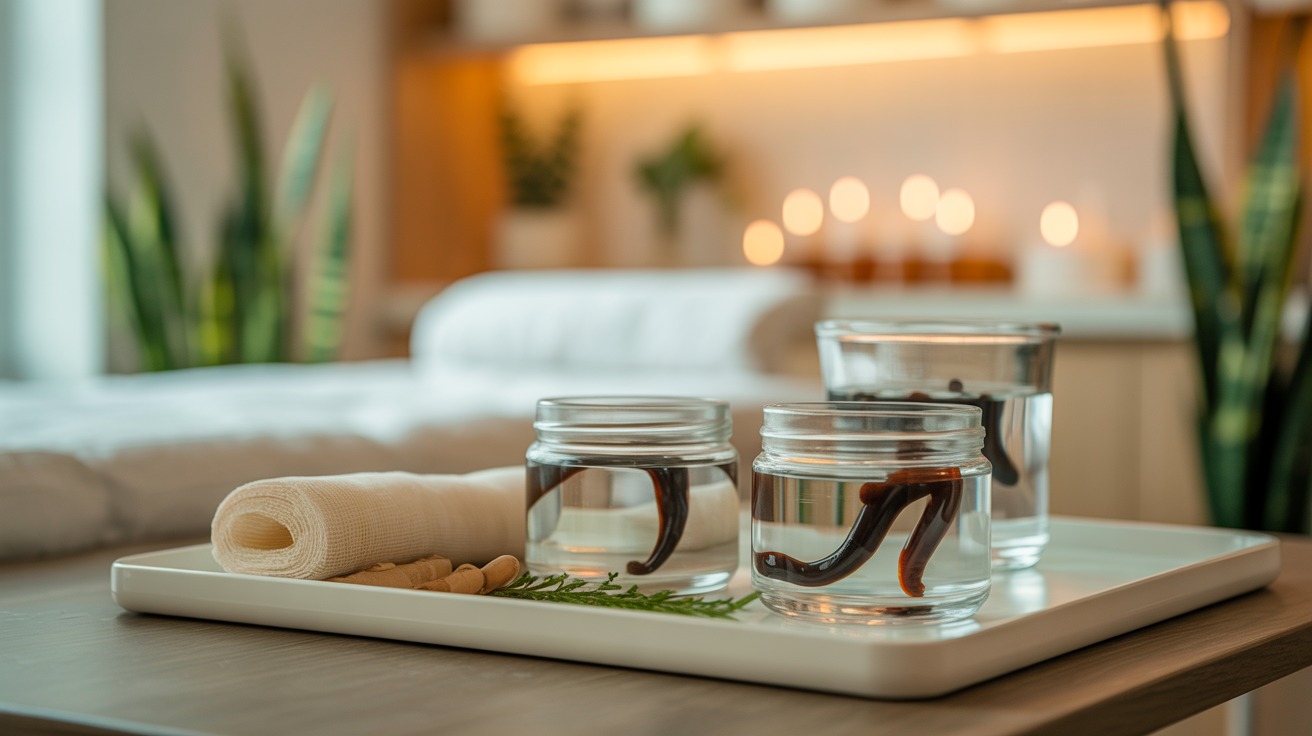
Hirudotherapy
What is hirudotherapy and why is modern medicine rediscovering it in the 21st century?
Planning your first visit?
If you are planning your first visit with us, we recommend filling out the health questionnaire before booking your chosen service. Based on the questionnaire, we will assess whether the service is suitable for you and, if necessary, recommend the next steps.
Fill out health questionnaire"Nature gave us the leech as a combined preparation that we should not give up again."
— Karl-Heinz Kuppe, German physician
The idea of leech therapy may evoke medieval medicine and a natural aversion in many people. However, the reality is completely different. Today, this method is successfully used in top plastic surgery clinics, cardiology, and gynecology worldwide. Tens of millions of leeches are applied annually around the world.
In this article, we will look at what exactly makes medicinal leeches so exceptional.
What is hirudotherapy?
Hirudotherapy is a therapeutic method using specially bred medicinal leeches (Hirudo medicinalis, or verbana). It is not quackery – in many countries (e.g., USA, Germany, Russia) the medicinal leech is officially recognized as a medicine or medical device. It saves tissues during transplants and treats dozens of chronic diseases.
How does this "living needle" work?
The effect of the leech is not limited to blood sucking. The leech acts on the human body in three complex ways:
1. Biochemical effect
Natural "micro-injection"
When attached, the leech acts as a natural "micro-injection." It injects saliva into the bloodstream containing more than 100 biologically active substances.
2. Reflex effect
Nervous system stimulation
The leech instinctively selects biologically active points on the skin (sometimes coinciding with acupuncture points). The bite stimulates the nervous system and reflexively affects the internal organ connected to that point.
3. Mechanical effect
Drainage and regeneration
After the leech detaches, the wound bleeds for 6 to 24 hours. However, not only blood flows out, but mainly lymph and tissue fluid. This process works as deep drainage: accumulated toxins are flushed from organs and internal pressure is released.
Key biologically active substances
The most important substances that the leech injects into the bloodstream include:
Hirudin
The most effective natural blood-thinning substance. It prevents the formation of blood clots (thrombi).
Destabilase
A unique enzyme capable of dissolving existing blood clots and regenerating fibrotic (hardened) tissue. A key helper for varicose veins and post-infarction states.
Hyaluronidase
Loosens intercellular spaces, allowing therapeutic substances to penetrate deep into organs.
Microcirculation normalization
The leech contains substances similar to histamine and the enzyme orgelase. These dilate capillaries, remove vascular spasms, and even support the formation of new vessels.
What do renowned experts and practice say?
Research and clinical practice of leading experts confirm the effectiveness of hirudotherapy.
Doctor Konstantin Sukhov
Physician, president of the World Association of Hirudotherapists
Focuses on physical body cleansing. Claims that leeches can "flush" the body's internal fluids and rid organs of waste.
Professor Albert Krashenuk
Scientist, St. Petersburg
Discovered the neurotrophic effect – leech saliva stimulates nerve cell growth. This helps children with cerebral palsy and adults after strokes.
Lidia Kuplevskaya
Physician, director of the Hirudo-Med center
In her daily practice, she demonstrates effectiveness in female infertility, endometriosis, prostate inflammation, thyroid and spine problems.
Citations from the scientific community
"In modern medicine, there are no drugs that can replicate the effects of a medicinal leech bite."
"No pill can dissolve an existing thrombus and normalize blood quality so quickly."
She found that substances from the leech stimulate the production of nitric oxide (NO), which relaxes blood vessels, reduces pressure, and acts against atherosclerosis.
Highlights that this treatment has virtually no age limitations and can be excellently combined with other forms of therapy.
Indications: When hirudotherapy helps
Sources agree that thanks to its complex action, the medicinal leech has extremely broad application across medical disciplines.
Cardiology and vascular system
High blood pressure (hypertension), ischemic heart disease, post-infarction states, atherosclerosis, varicose veins, thrombophlebitis, hemorrhoids, and lymphostasis.
Gynecology and urology
Infertility, endometriosis, uterine fibroids, cysts, chronic inflammation, painful menstruation, chronic prostatitis, prostate adenoma.
Neurology
Post-stroke states, migraines, headaches, radiculitis, neuralgia, and cerebral palsy.
Gastroenterology and endocrinology
Chronic gastritis, cholecystitis, pancreatitis, thyroid diseases, obesity, and diabetes support.
Musculoskeletal system and surgery
Arthritis, arthrosis, osteochondrosis, gout, rheumatoid arthritis, postoperative complications, and use in plastic surgery.
Dermatology, ophthalmology and ENT
Psoriasis, eczema, acne, glaucoma, middle ear inflammation, tinnitus, and allergic diseases.
Contraindications: When hirudotherapy is prohibited
Authors and physicians define exact conditions when leeches must not be used. The list is divided into absolute and relative contraindications.
A. Absolute contraindications (Strict prohibition)
These conditions exclude the use of leeches under any circumstances:
Hemophilia and congenital bleeding disorders: Absolute contraindication due to missing blood clotting factors.
Blood and hematopoietic disorders: Hemorrhagic diatheses (bleeding tendency), thrombocytopenia, acute and chronic leukemias, lymphogranulomatosis, and bone marrow tumors.
Severe anemia: Hemoglobin levels below 100 g/l (some authors specify below 110 g/l). Blood loss could endanger the patient.
Malignant tumors and metastases: Rapidly developing neoplasms and malignant processes of any location.
Active internal bleeding: Including active bleeding in the digestive tract.
Acute ulcers and erosive gastritis: Acute gastric and duodenal ulcers.
Severe infections and acute conditions: Active pulmonary tuberculosis, acute febrile and septic states.
Immunodeficiencies: Acquired immunodeficiency syndrome (AIDS) and HIV carrier status.
Conditions during chemotherapy and radiotherapy: Patients undergoing oncological treatment.
Severe hypotension (low blood pressure) and circulatory failure: States of shock, collapse, or fainting.
Extreme physical exhaustion (cachexia).
Surgical and vascular anomalies: Intracranial aneurysm, abdominal aortic aneurysm, and spleen removal.
Mental conditions and addictions: States of severe psychological agitation, severe psychiatric disorders, alcohol intoxication.
Intoxications: Concurrent external use of large doses of mercury preparations.
Individual intolerance and severe allergies: Severe allergy to leech saliva components.
B. Relative contraindications and limitations
Require medical approach and caution:
Use of blood-thinning medications (anticoagulants): If the patient is permanently taking warfarin or heparin, medical consultation is necessary.
Pregnancy and postpartum period: Generally considered a contraindication due to miscarriage risk from systemic effects.
Menstruation: During the "critical days" it is recommended to interrupt the treatment.
Acute respiratory diseases: Flu and high fever are reasons to postpone the session.
Long-term corticosteroid treatment: Or other immunosuppressants that suppress immunity.
Tendency to form keloid scars: In such patients, the bite may leave permanent cosmetic marks.
Liver cirrhosis: A high-risk bleeding condition.
Post-dialysis patients and very elderly people: Treatment must proceed with maximum caution.
Panic fear: Extremely negative patient attitude toward leeches prevents successful treatment.
Conclusion
Hirudotherapy is not a return to the past, but a utilization of millions of years of evolution. It is a scientifically based and safe method that revives the body's self-healing abilities where traditional pharmacology reaches its limits.
Want to learn more?
If hirudotherapy interests you, try hirudo.wiki — an AI knowledge system specially adapted for questions about hirudotherapy.
An interesting feature is the so-called arbiter system — if the AI detects a diagnosis in your question, it automatically generates 9 questions for different agents.
Go to hirudo.wikiInterested in a consultation?
We will gladly explain how hirudotherapy can help specifically in your case.